4 Ways to Encourage Employees to Use AI

Having spent 20 years in corporate innovation, here are my notes on what we are seeing in AI adoption.
The Stick
Where most companies are today (and the best documented, b/c the tactics generate headlines). Mandates, usage scores, performance reviews. The Stick produces a number, which is why leadership likes it. But measuring activity is not the same as measuring adoption. Wharton study found 31% of U.S. knowledge workers are actively working against their company's AI initiatives. You can hit every target and still have a workforce that has learned to look busy. Accenture and Meta are tracking usage and linking adoption to promotion eligibility. My worry is that you end up with a workforce that's very good at hitting the number.
The Carrot
I like rewards tied to outcomes better than counting logins, but I'm not sure those metrics tell you whether anyone's doing anything differently, or just getting better at hitting a different number. Daniel Pink showed decades ago that extrinsic rewards undermine cognitive work, and I don't see a reason that's changed. Shoosmiths offered a £1M bonus pool for staff hitting one million Copilot prompts. They hit it four months early. Good for setting the tone, but the question is whether the behavior underneath actually changed.
The Spotlight
This is where it gets interesting to me. It also feels more human. Citi built a network of 4,000 AI Accelerators over two years, recognizing champions through internal badges, weekly callouts, and shared prompt libraries. I think this approach is genuinely better. My reservation is that it's still focused on visible activity rather than outcomes.
The Canvas
Where I think you want to be. When Moderna deployed ChatGPT Enterprise in 2024, they didn't set targets or mandate usage. They gave every employee a platform to build tools for their own problems. Within two months, 750 custom GPTs had been created, such as contract scanners, dose verification tools, a benefits GPT handling 80% of routine HR inquiries. That number has grown to over 3,000 employee-built tools. Their CEO put it simply: "With a few thousand employees, we are scaling like a company of one hundred thousand."
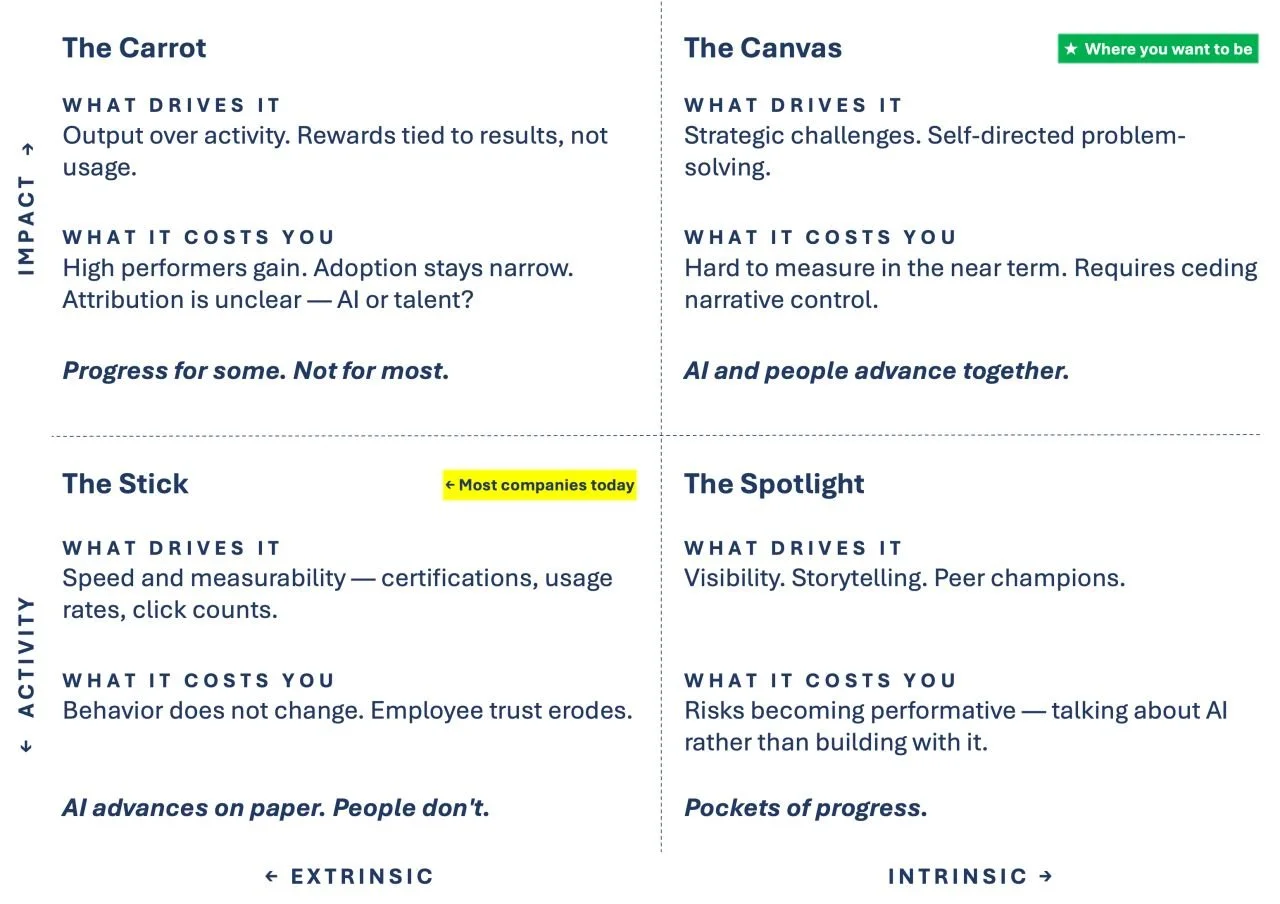
I view everything on the left of the x-axis like a battery — charged from outside, depleted over time, and adding friction rather than removing it. Everything on the right is a generator — self-sustaining once running. The companies I find most interesting aren't necessarily designing better incentives but are handing people real problems to own and getting out of the way. Could the energy you'd spend on incentive design go toward empowering your talent instead?